
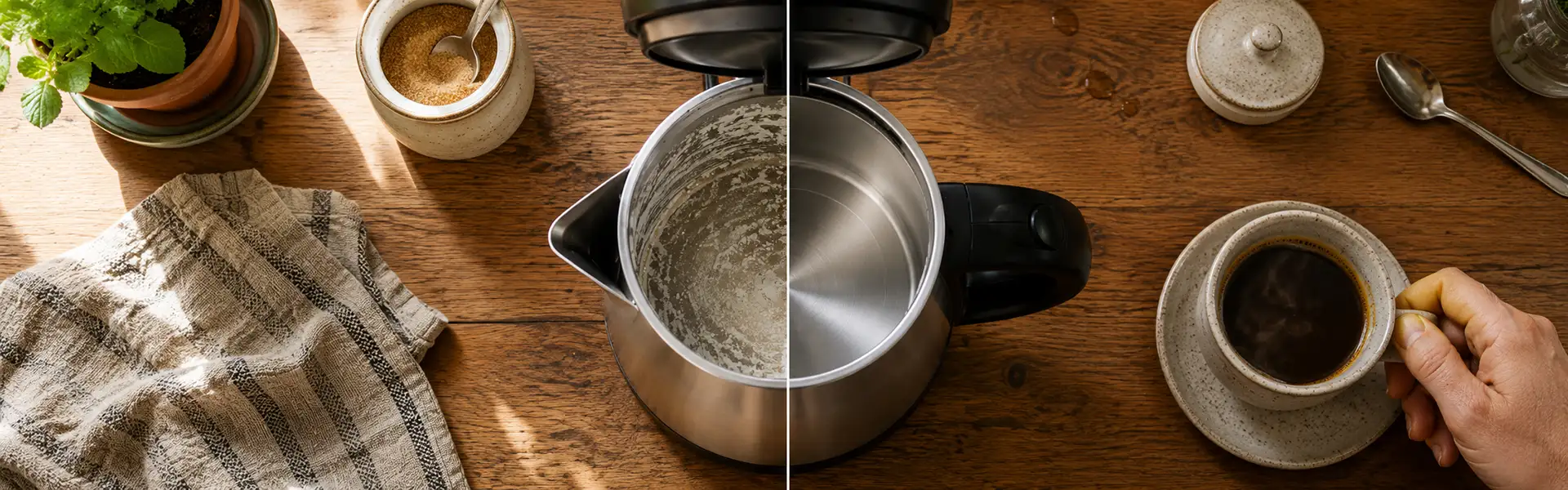
HOW TO DESCALE KETTLE
(Quickly & Easily)
QUICK ANSWER
How to Descale a Kettle:
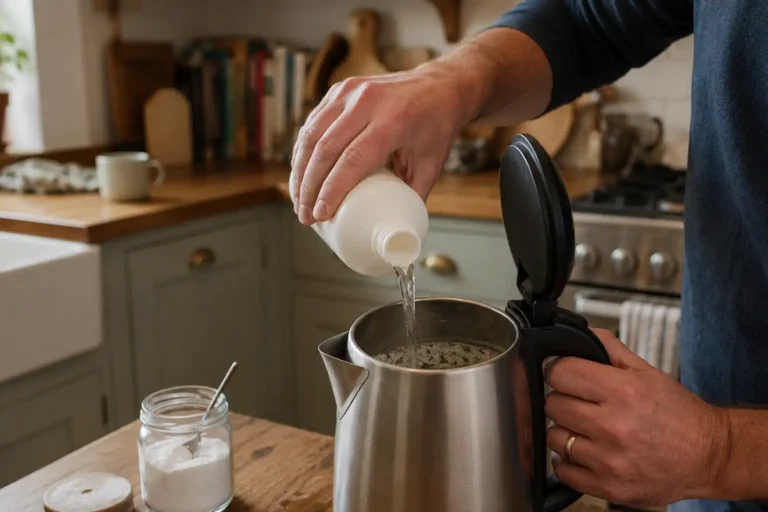
Add a prepared acid solution to an empty kettle.
Any of these 3 works:
- White vinegar: Equal parts vinegar and water, enough to cover the scale.
- Citric acid powder: 1 tablespoon per 500ml of hot water (Mix Well).
- Descaling solution: 2 fl.oz (Halefresh DS – has a handy built-in measuring chamber), then fill to the max line with cold water.
– Then:
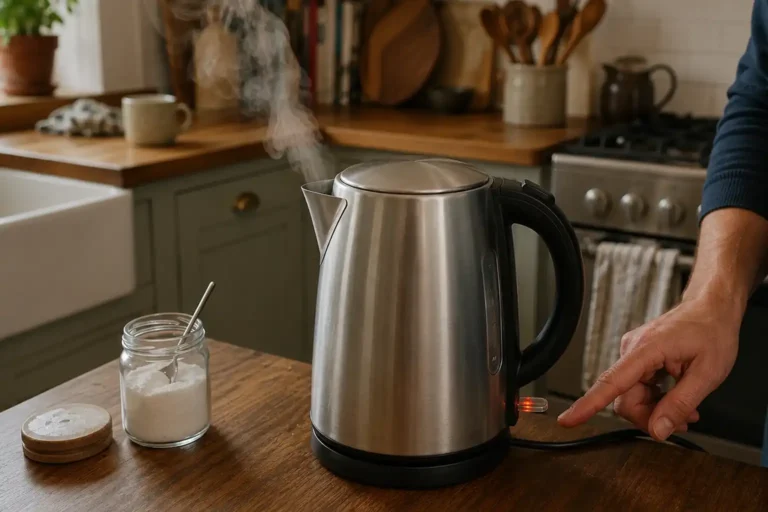
- Boil the kettle, switch it off and unplug it.
- Wait 20 minutes for citric acid descaling solution (homemade or bought), 30 to 60 minutes for vinegar. The acid eats the limescale while you get on with your day.
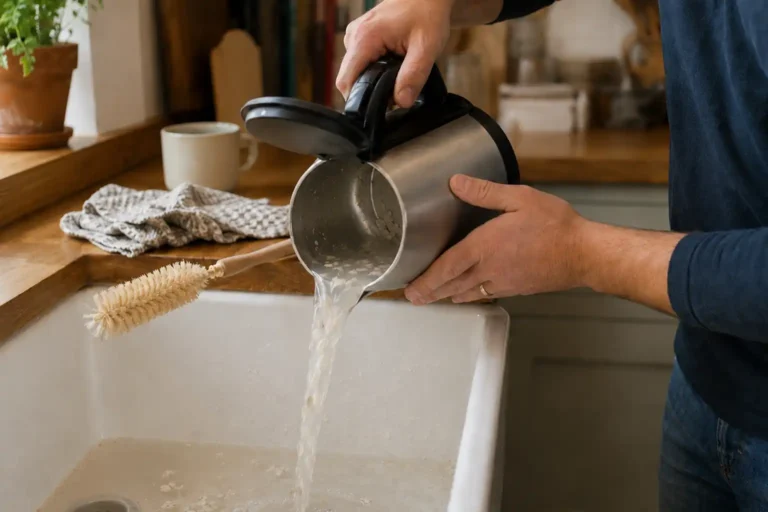
- Tip it out and wipe away any loose flakes with a soft cloth or brush. They fall away with almost no effort.
- Rinse two or three times, then boil a kettle of fresh water and pour it away.
- Done. Repeat monthly if you live in a hard water area, every two to three months if you don’t (use your eyes).
KETTLE DESCALING IN PICTURES

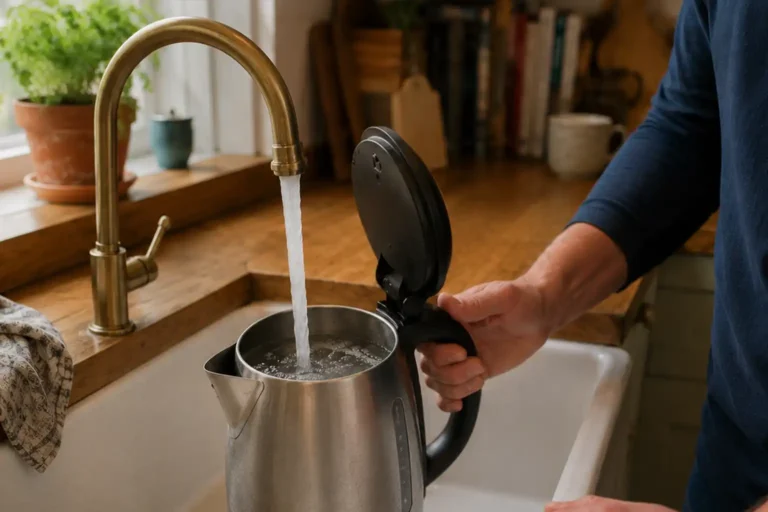
Why your Kettle Scales-up in the First Place
Here’s the short version: your tap water carries dissolved chalk, calcium and magnesium minerals. When you boil it, some of that chalk drops out of the water and sticks to the hottest surfaces. That white, crusty film on the base and around the element? That’s limescale. Calcium carbonate, mostly.
It’s harmless to drink. Truly. It’s the same stuff as in a calcium supplement. But it wrecks everything else:
- It slows your kettle down. Scale insulates the heating element, so the kettle burns more power and takes longer to boil. Descale it, and your kettle boils faster and your electricity bill thanks you.
- It ruins the taste. Flakes of chalk drift into your cup. If you care about coffee (and around here we care about coffee more than is strictly reasonable), scale flattens the water chemistry and mutes the brew.
- It kills kettles. Scale makes the element overheat. Elements that overheat die young. A thirty-minute descale every month buys your kettle years.
We know this one first-hand. The water at Halefresh HQ is hard enough that white film shows up on our hot water dispenser within three days of cleaning it. We didn’t get into descaling as a hobby; the water forced our hand.
The fix is simple chemistry: limescale is alkaline, so a mild acid dissolves it: descaling solution, citric acid, vinegar, lemon juice. Pick one.
They all work, and we’ll walk you through each one honestly, including the free ones.
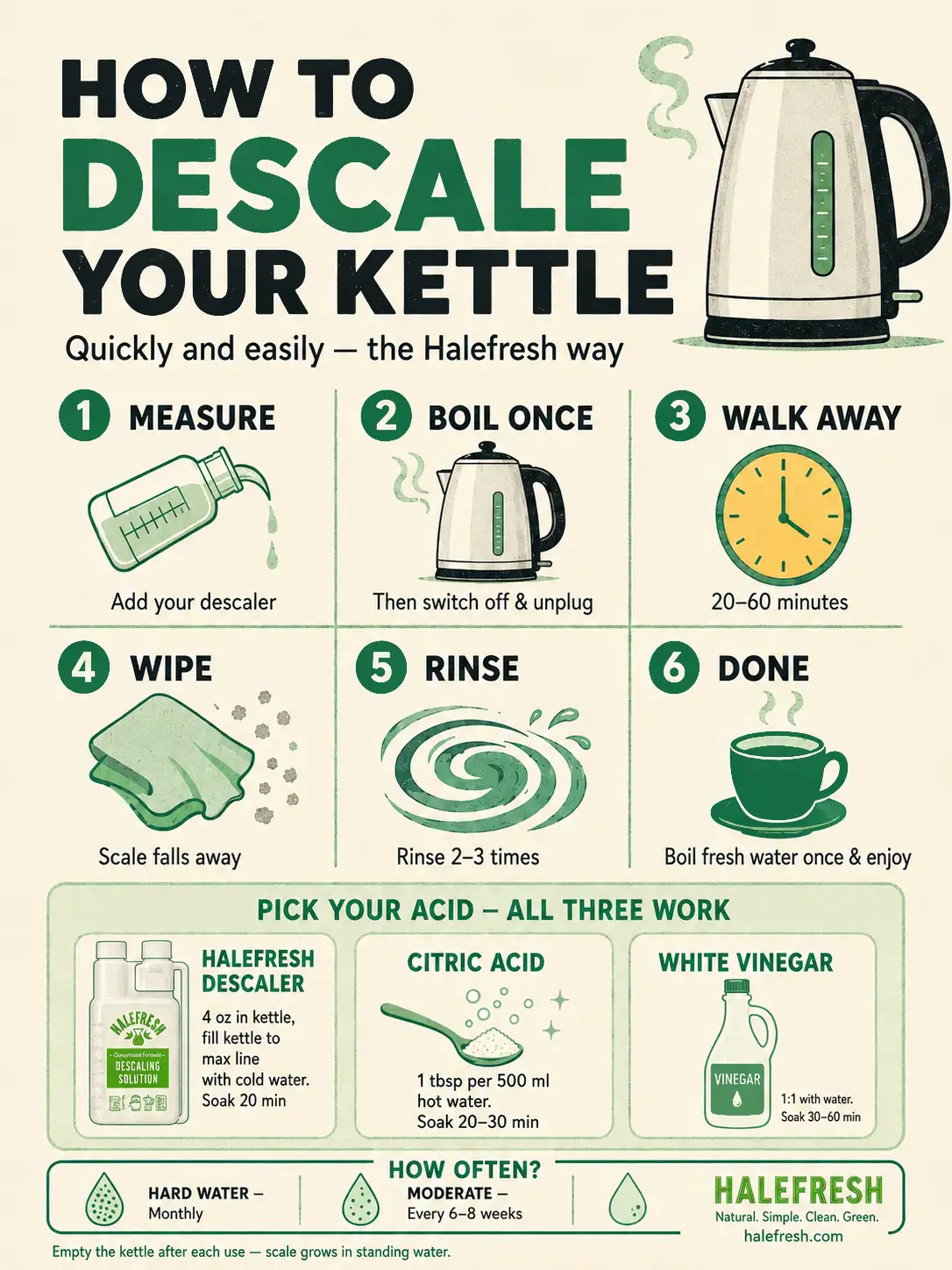
How to Descale a Kettle with Descaling Solution or Citric Acid (What We Use)
Citric acid is the acid we built our business on, and here’s why it wins for kettles: it descales as hard as vinegar or harder, it has no smell, it rinses away completely, and it leaves no aftertaste to chase out of your morning tea. Most kettle and coffee machine makers quietly point you toward citric-based descalers for exactly these reasons.
You have two routes, and we sell both, so take your pick:
Route 1: Ready-Made Descaling Solution
Halefresh descaler solution is purified water and citric acid. Nothing else. No fillers, no dyes, no perfume. The bottle has a built-in 1 oz measuring chamber: squeeze the bottle, the chamber fills to the line, pour the dose. No guessing, no measuring spoons, no “how much do I use?” That question is the single most-searched confusion in descaling, and the chamber answers it before you can ask.
Step by step:
1. Squeeze 2 oz into the kettle (two fills of the chamber), then fill to the max line with cold water.
2. Bring it to a boil, switch off, unplug.
3. Let it sit for 20 minutes.
4. Pour it away. The scale goes with it, or sits in soft flakes you can wipe off with a cloth.
5. Rinse thoroughly, boil fresh water once, and discard.
One 16 oz bottle holds enough to clean your kettle 8 times. However, we know from experience that life isn’t that regimented, and after your first descale you’ll likely find you need less per round (if you descale by the calendar), or your bottle will go further if you descale when you eyeball the buildup and decide it’s time.
Route 2: Mix your Own with Citric Acid Powder
Prefer to DIY? Good. It’s not a state secret and we won’t pretend otherwise. Stir 1 tablespoon of citric acid (about 15g) per 500ml of hot water straight into the kettle. Two tablespoons in a litre for a big or badly scaled kettle. Boil, wait 20 to 30 minutes, pour, rinse.
A 3lb pouch of citric acid descales your kettle, your coffee machine (and your showerhead) for the better part of a year, and it costs less per clean than any method except vinegar. It fizzes gently when it meets the scale. That fizz is the sound of your problem dissolving.
How to Descale a Kettle with Vinegar(The Classic Free Method)
White vinegar works, it’s cheap, and it’s probably already in your cupboard. We’d be a strange company if we pretended otherwise, so here’s the method in full, no tricks.
How much vinegar to descale a kettle: Equal parts white vinegar and water. For most kettles, 500ml of each covers the element and the worst of the scale. You don’t need to fill the kettle; the acid only needs to touch the scale.
Step by step:
1. Pour in the vinegar and water mix.
2. Boil the kettle once. Heat makes the acid work harder and faster.
3. Switch off, unplug, and leave it. How long to descale a kettle with vinegar? Thirty minutes shifts light scale. An hour shifts heavy scale. For a truly crusted kettle, the kind that rattles when you shake it, empty it after an hour and run the whole thing again with fresh solution. Don’t leave vinegar sitting overnight in a kettle with rubber seals or a plastic body; a long acid bath can bother the seals, and it gains you nothing.
4. Pour the solution away and wipe out the flakes with a cloth or soft brush. No scouring pads. They scratch, and scratches give the next round of scale somewhere to grip.
5. Rinse well (more on rinsing below).
Which Vinegar?

Plain white vinegar. It’s the cheapest and it rinses cleanest. Apple cider vinegar, white wine vinegar, even malt vinegar all dissolve scale, because acid is acid (acetic acid to be exact here), but they cost more and they smell like a chip shop. Save them for food.
So why don’t we use it?
Three honest reasons. The smell fills the kitchen and clings through the rinses. Household vinegar is only around 5% acid, so it works slower and weaker than citric acid mixed at a useful strength. And a few kettle makers (Fellow among them) steer owners away from vinegar on coated and polished finishes. None of that makes vinegar wrong. It makes it the free method with the most drawbacks, and now you know all of them.
Getting rid of that vinegar taste:
Rinse two or three times, then boil a full kettle of fresh water and tip it away. If a ghost of vinegar lingers, boil once more with a teaspoon of baking soda in the water (the baking soda cancels the acid), then rinse and boil clean water one last time.
How to Descale a Kettle with Lemons(The Natural One)
Want to descale a kettle as Mother Nature intended, with something from the fruit bowl? Lemon works. It’s citric acid wearing its Sunday clothes.
How much lemon juice to descale a kettle:
The juice of three whole lemons (or about 1.5 cups of bottled lemon juice) per 500ml of water. Or slice the lemon into rounds, drop them in, and top up with water; the slices release acid as they heat, and your kitchen smells wonderful.
1. Add lemon (juice or slices, quarters if your knife skills are as bad as mine) and water.
2. Boil, then leave for an hour. Lemon is gentler than measured citric acid, so give it longer.
3. Pour away, wipe, rinse twice, boil fresh water once.
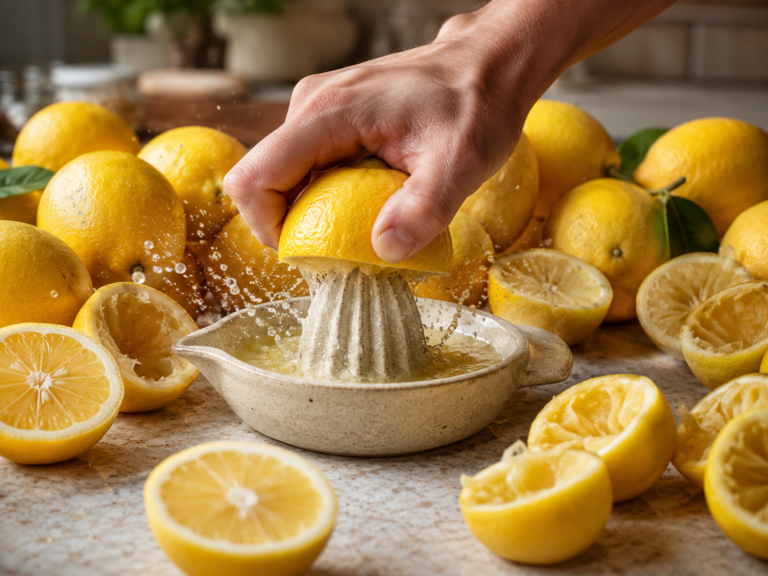
Lemon is the gentlest method here, so heavy scale may need two rounds or more. But for a light monthly clean, it’s lovely.
How to Descale a Kettle Without Vinegar(or Harsh Chemicals)
If the smell of hot vinegar makes you leave the house, you have options, and every one of them is gentle:
Citric acid or a citric-based descaler. See above. The best all-rounder, full stop. Citric acid comes from fermenting sugars, it breaks down quickly, and it leaves nothing caustic behind.
Lemon juice. Natural, gentle, smells great (mentioned already). Requires frequent application (or a lot of lemons and manual labour if hard scale builds up)
Descaler tablets. All of them are acids in a fancy coat.
How to use descaler tablets in a kettle: Boil half a kettle, drop the tablet in, wait until it stops fizzing (15 to 30 minutes), empty and rinse three times.
All “chemical-free” really means here is “acid you’d happily put on a pancake.” Lemon and citric acid are exactly that. One plain-speaking note, the same one we print on our own bottles: food-safe does not mean drink-it. A concentrated acid solution will sting skin and worse. Mix it, use it, rinse it, and keep it away from anyone who thinks food-grade means fair game.
Vinegar will dissolve limescale, but it is harder to control and less consistent in practice. It works as a short-term fix, not always as the best long-term approach.
What About Baking Soda, Coke and the Weird Ones?
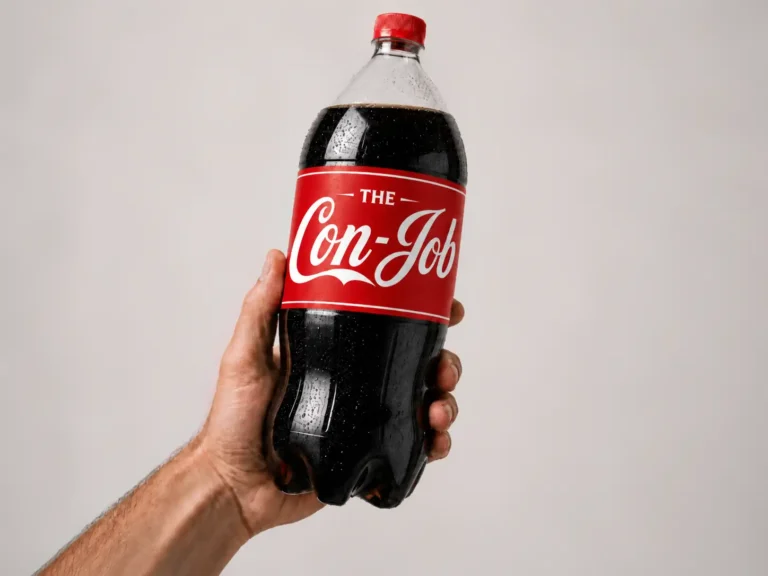
You’ll see these all over the internet, so let’s be straight with each other:
Baking soda (bicarbonate of soda): Honestly? It barely works on limescale. Baking soda is alkaline, and limescale is alkaline, so you’re sending a pacifist to a fistfight. It scrubs tea stains beautifully and it neutralises vinegar smell, so it earns its place in the routine. But as a descaler on its own, no. Anyone telling you otherwise hasn’t checked their kettle’s base.
Vinegar and baking soda together: A fun fizz, mostly for show. The fizz is the two cancelling each other out, which means you’re weakening your vinegar. Use vinegar alone, then baking soda after to kill the smell. In that order, both shine.
Coke: It genuinely works, since it carries phosphoric acid, but it leaves a sugary film you then have to clean off, and it costs more than vinegar. A party trick, not a method.
Dishwasher tablets and denture tablets: They’ll loosen scale, but they’re built for other jobs and their leftovers don’t belong in your tea. Citric acid is cheaper and made for exactly this. Skip them.
Descaling by Kettle Type
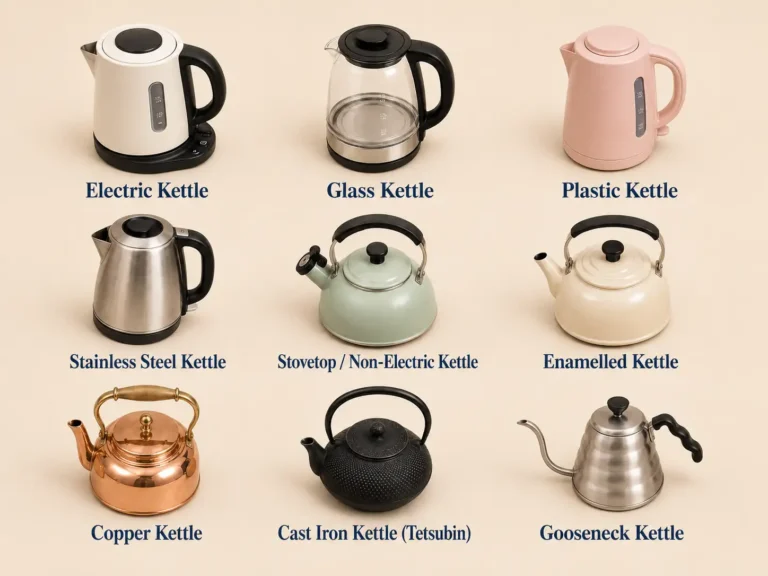
The chemistry doesn’t care what your kettle is made of, but a few details do change:
Electric kettles: Everything above applies. Just make one rule sacred: unplug before you soak, and never dunk the kettle or its base in water. Descale the inside only.
Glass kettles: Descale exactly as above. The joy of glass is you can watch the scale let go. Rinse well and buff the outside dry and it looks showroom-new.
Plastic kettles: Citric acid and vinegar are both safe for the plastic. Keep soaks to an hour or less to be kind to the seals, and rinse an extra time, because plastic holds onto smells longer than steel.
Stainless steel kettles: All methods work. Don’t scrub with anything harsher than a soft brush, and don’t leave strong acid sitting for many hours; a long soak can dull a polished finish. Twenty minutes to an hour is plenty.
Stovetop and non-electric kettles (tea kettles): Same solution, same soak. You can simmer the mix gently for ten minutes instead of a single boil; it speeds heavy scale along. Enamelled kettles like Le Creuset take acid inside without complaint; just keep it off the painted outside and wipe spills straight away.
Copper kettles: Descale the inside as normal. Keep the acid off the polished outside unless you want bright patches, because acid strips copper’s patina where it touches.
Cast iron kettles (tetsubin): Stop! Don’t descale these at all. That pale mineral lining inside a Japanese cast iron kettle protects the iron from rust. Scrub it out and the kettle rusts. Rinse with plain water, dry thoroughly, and leave the scale be. This is the one kettle where the crust is your friend.
Gooseneck kettles: Descale as normal, then pour a cupful of the warm solution out through the spout, slowly, before you rinse. Scale loves hiding in that long thin neck, and this flushes it.
Fellow, Smeg, Breville and Friends: Brand Notes
Search any brand (Fellow, Breville, Smeg, Cuisinart, Hamilton Beach, Cosori, Russell Hobbs, KitchenAid, Ninja, Bodum, Bonavita, Dualit) and the answer is the same: the methods above work, because scale is scale. A few honest notes:
Fellow Stagg (and other precision gooseneck kettles): Fellow points owners toward citric-based descaling powders rather than vinegar, and we agree, for obvious reasons and honest ones too. Citric acid is kinder to polished finishes and matte coatings. One 2 oz dose or one tablespoon of powder per 500ml, 20 minutes, flush the spout, rinse. Your Stagg will pour like new.
Smeg and other painted-body kettles: Descale the inside freely; keep acid off the painted shell and wipe drips fast.
Breville, Cuisinart, Hamilton Beach, Cosori, Russell Hobbs and the rest: Citric acid or 1:1 vinegar, 20 to 30 minutes, rinse three times. Check the manual if you’re within warranty; a few brands name a preferred descaler, and using a plain citric-based one keeps both the machine and the paperwork happy.
How to descale the kettle spout: Soak a strip of kitchen paper in your descaling solution and drape it over and into the spout for half an hour. For limescale on the outside, wipe with a solution-damp cloth, then a water-damp cloth, then dry. Never submerge an electric kettle.
Dealing with fingerprints, grease, tea stains or scorched patches rather than limescale? Our guide to how to clean a tea kettle covers the complete inside-and-out cleaning routine.
How Often Should you Descale a Kettle?
Hard water area: Once a month. Put it on the calendar next to paying the rent.
Moderate water: Every 6 to 8 weeks.
Soft water area: Every 2 to 3 months.
Visible white crust or flakes in your cup: today. Right now. The kettle is asking nicely.
You’ll know your water is hard if scale returns within a couple of weeks, if your taps grow white rings, or if your soap won’t lather. Little and often beats a heroic quarterly battle. A light monthly descale takes ten minutes of actual effort and your kettle never gets bad.
If monthly sounds like a habit you’ll forget, that’s exactly why we run Subscribe & Save on descaling solution. The bottle turning up is the reminder. No app, no alarm, just a parcel that says “it’s time.”
How many Times Should you Rinse After Descaling?

Two to three rinses, then one throwaway boil. That’s the rule, whatever acid you used.
1. Rinse with cold water, swirl, pour away. Do that two times.
2. Fill with fresh water, boil, pour the whole lot away.
3. Vinegar users: if you can still smell it, boil once with a teaspoon of baking soda, rinse, and boil clean water one final time. Citric acid users get to skip this step, which is rather the point.
The first cup after a descale should taste like nothing at all (plain water that is; the first brew will celebrate the flavour of the beans/leaf you cherish).
That’s the goal: water that gets out of the way and lets your tea or coffee speak.
Keep the Scale from Coming Back
Empty the kettle after each use. Standing water evaporates and leaves its minerals behind. An empty kettle scales far slower. This one habit halves your descaling.
Fill with filtered water. A simple jug filter pulls out much of the hardness before it ever meets the element, and filtered water brews noticeably better coffee, which is the honest reason half of us here do it.
Boil only what you need. Less water boiled, less mineral dropped, faster cuppa. Everyone wins.
Try a kettle descaler ball. A small stainless mesh ball that lives in the kettle and gives scale something to grab instead of your element. Drop it in, and every few weeks rinse it under the tap and squeeze the flakes out. Cheap, low-effort, surprisingly effective.
One caution from our own kitchen: Don’t chase perfectly pure water. We ran a kettle on reverse osmosis water expecting a scale-free life, and instead of white limescale we got a thin brown film that fought harder than the chalk ever did. Lightly filtered water beats ultra-pure water for both your kettle and your coffee.
Quick FAQ
Is limescale harmful?
No. It’s calcium and magnesium, minerals your body uses. It tastes chalky and it murders kettles, but it won’t hurt you.
How long do I leave descaler in the kettle?
Descaling solution: 20 minutes. Citric acid: 20 to 30 minutes. Vinegar: 30 to 60 minutes. Lemon: an hour. Longer soaks past these times gain little.
My kettle still tastes of vinegar. Help.
Boil a teaspoon of baking soda in fresh water, pour away, rinse, boil clean water once. Gone. (Or switch to citric acid next time and retire this problem for good).
Does descaling make the kettle boil faster?
Yes. Scale is an insulating blanket over the element. Strip it off and heat pours straight into the water again.
Can I use the same methods on my coffee machine?
The chemistry is the same, but coffee machines have pumps, valves and boilers with their own rules. We’ve written the full guides: how to descale a coffee maker, can you descale a coffee maker with vinegar, and the best descaling solution for coffee machines.

