
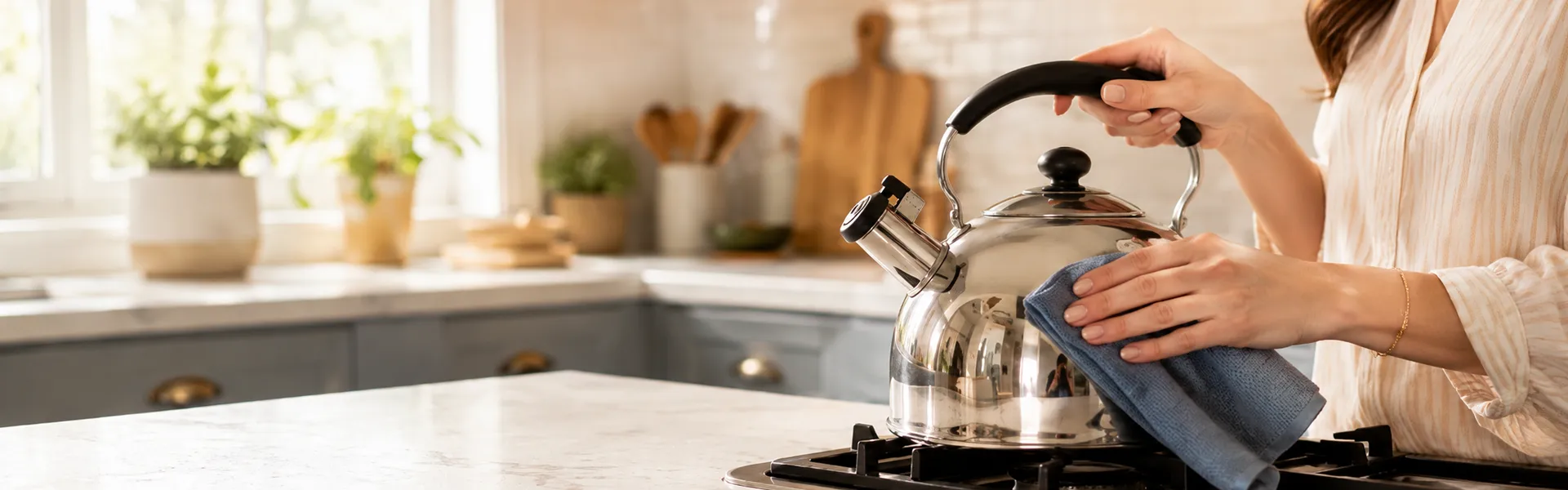
HOW TO CLEAN TEA KETTLE
(Inside & Out, the Easy Way)
QUICK ANSWER
How to Clean a Tea Kettle:
Your tea kettle gathers two kinds of grime, and each one falls to a different weapon:
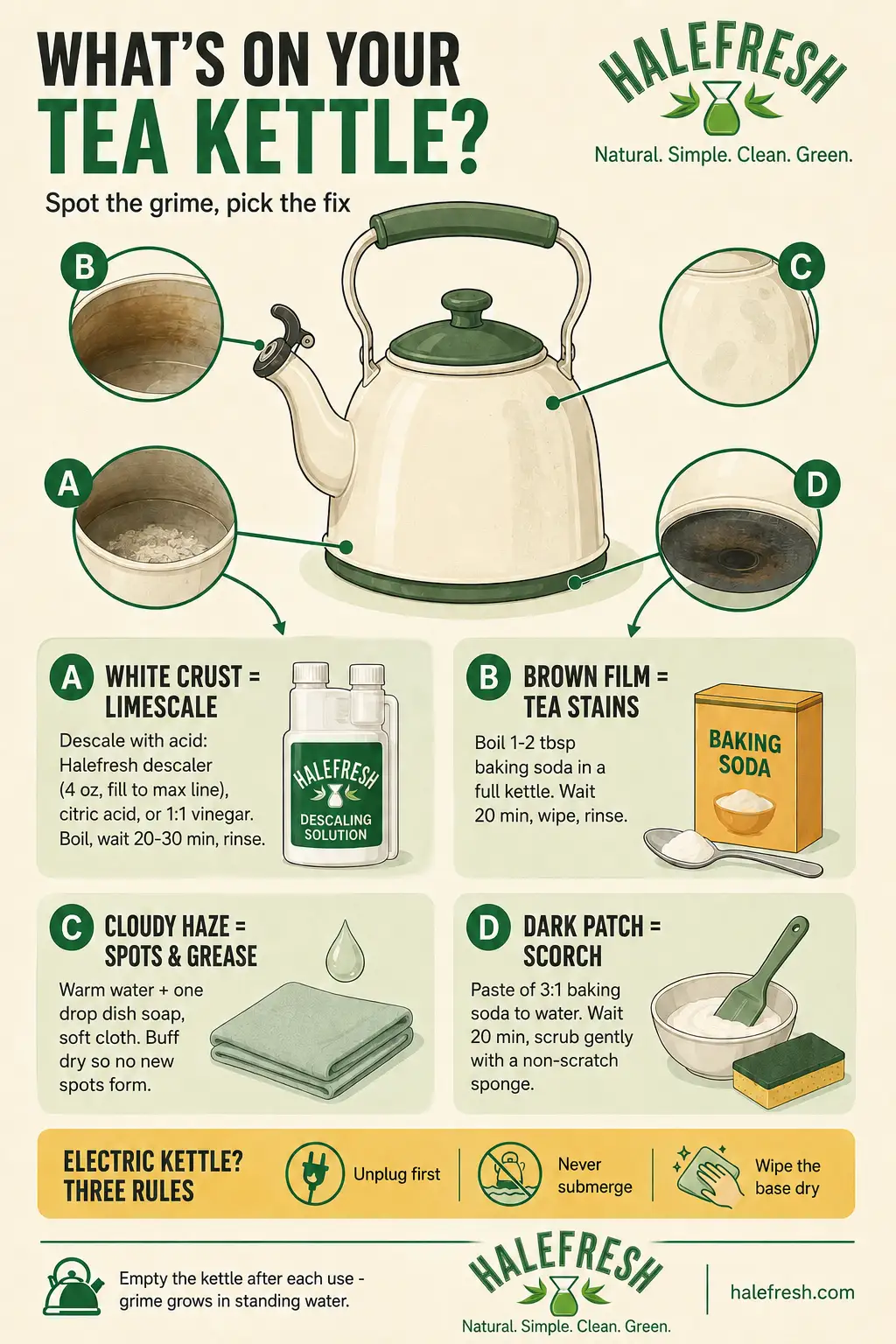
- Inside (white crust / limescale): Add a mild acid, descaling solution (4 fl oz, then water to the max line), citric acid (1 tablespoon per 500 ml hot water), or 1:1 white vinegar. Boil once, wait 20–30 minutes, tip it out, rinse two or three times.
- Inside (brown tea stains): 1–2 tablespoons of baking soda in a full kettle of water. Boil, wait 20 minutes, wipe with a soft sponge, rinse.
Outside (grease, fingerprints, water spots): Warm water, a drop of dish soap, a soft cloth. Buff dry with a dry cloth so no new water spots form.
Outside (burnt or scorched patches): Baking soda paste (3 parts soda, 1 part water). Spread it on, wait 20 minutes, scrub with a non-scratch sponge, rinse, dry.
Electric kettles: All of the above — but unplug first, and never dunk the kettle or its base in water. Wipe, don’t submerge.
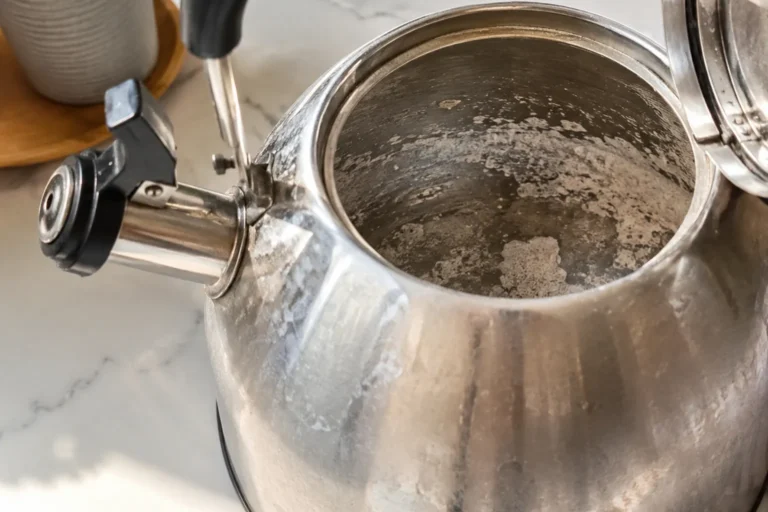
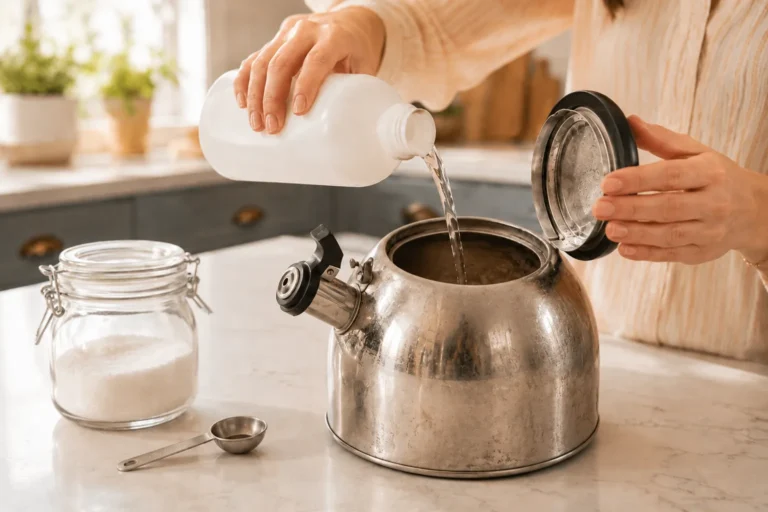
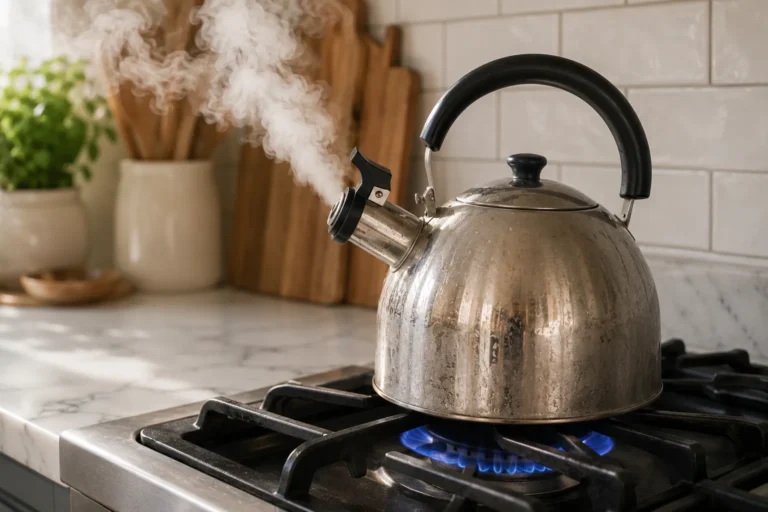
TEA KETTLE CLEANING IN PICTURES
The Two Kinds of Kettle Grime
(and why you fight them differently)
Here’s the thing most cleaning guides skip: a kettle doesn’t get dirty in one way. It gets dirty in two, and they’re opposites.
Inside, you get limescale. Your tap water carries dissolved calcium and magnesium. Boil the water, and some of that chalk drops out and grips the hottest metal. That’s the white crust on the base. It’s alkaline, so it dissolves in a mild acid: citric acid, vinegar, lemon. We wrote the whole playbook on this one: how to descale a kettle walks through every method, every kettle type, and every “will Coke work?” myth. If your only problem is white crust, go there. This page covers everything else too.
Outside (and sometimes inside), you get everything acid can’t touch. Tea tannins paint brown film on the walls. Cooking grease drifts over from the hob and settles as a sticky haze. Water spots dry into cloudy rings. A dry boil scorches the base. None of that is limescale, and acid mostly shrugs at it. This grime falls to soap, baking soda, and a soft cloth.
Get that distinction straight and kettle cleaning stops being a mystery. Acid for chalk. Soap and soda for the rest. Everything below is just that rule, applied.
How to Clean the Inside of a Tea Kettle
Step 1: Kill the Limescale (the Short Version)
The fast route, and the one we use at Halefresh HQ (our water is hard enough to fur a kettle in a fortnight):
1. Add 4 fl.oz of Halefresh descaling solution (the bottle’s built-in chamber measures it for you) or 1 tablespoon of citric acid per 500ml of hot water. No citric acid in the house? Equal parts white vinegar and water works too — it just smells like a chip shop and needs extra rinsing.
2. Boil once. Switch off. Unplug if it’s electric.
3. Wait 20 to 30 minutes. The acid eats the scale while you drink the tea you made before you started. (You did make one first, didn’t you?).
4. Tip it out, wipe away the soft flakes, rinse two or three times, boil fresh water once and pour it away.
That’s the condensed version. Amounts for every acid, soak times for every level of crust, and the honest truth about vinegar, lemon and Coke all live in the full guide: how to descale a kettle.
Step 2: Shift the tea stains
Stovetop tea kettle with brown-stained walls? That’s tannin, not scale, and here baking soda finally gets its moment (it’s useless against limescale: it’s alkaline, scale is alkaline, nobody wins that fight).
1. Fill the kettle with water and stir in 1 to 2 tablespoons of baking soda.
2. Boil, switch off, and wait 20 minutes.
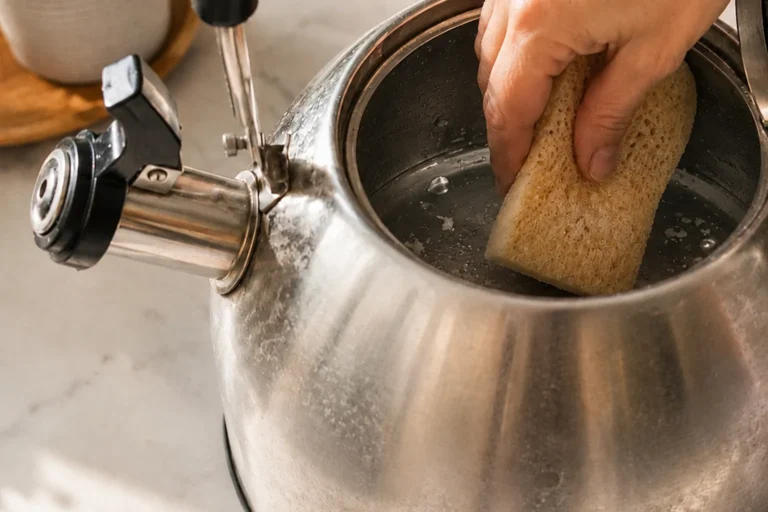
3. Wipe the walls with a soft sponge. The brown film slides off.
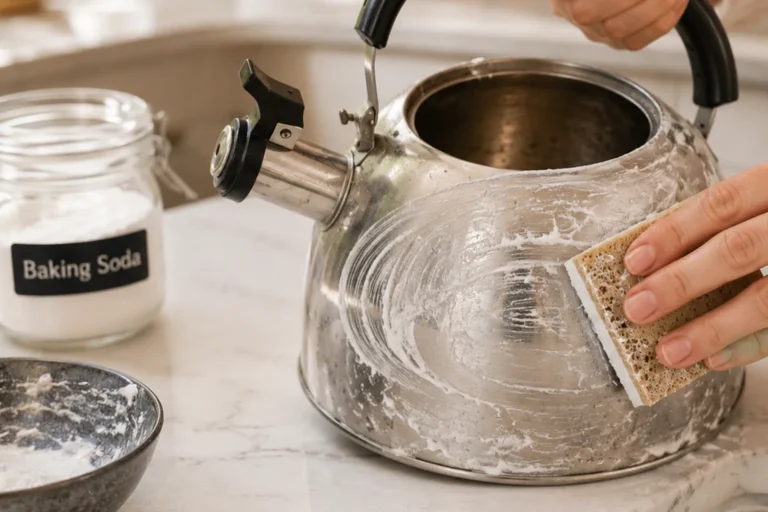
4. Rinse well and boil once with fresh water. For a stubborn ring at the waterline, make a paste (three parts baking soda to one part water), rub it on with a cloth, wait ten minutes, wipe and rinse.
One order-of-operations tip from people who clean kettles for a living: descale first, stains second. Half the “stain” is usually scale wearing a tea-coloured coat, and the acid takes it out in round one.
How to Clean an Electric Kettle
Everything above applies, plus three rules that keep you and your kettle alive:
• Unplug before you clean. Every time. No exceptions.
• Never submerge the kettle or its base. The heating element and the contacts live down there. Water kills them. Wipe, don’t dunk.
• Keep liquid out of the base connector. When you rinse, tip water away from the socket in the kettle’s underside.
Inside: descale as above (acid, boil, wait, rinse). If your electric kettle has a mesh limescale filter in the spout, pop it out and drop it in a cup of your descaling solution while the kettle soaks. Ten minutes and the mesh runs clear again. Rinse it, click it back.
Outside: wipe with a damp, soapy cloth, then a water-damp cloth, then buff dry. For a stainless body, wipe with the grain of the metal and finish with a dry microfiber cloth; that’s the whole secret to a fingerprint-free kettle. For a glass kettle, a 1:1 vinegar-water spritz on a cloth (never sprayed at the kettle) melts water spots and leaves the glass bright.
The base: unplug it, then wipe with a barely-damp cloth and dry it before you plug back in. Crumbs and dust like to gather under there. Evict them.
How to Clean a Kettle with Vinegar
(Inside and Out)
Vinegar is the cupboard classic, and it earns its keep in two jobs:
Inside: equal parts white vinegar and water, boil once, wait 30 to 60 minutes, rinse until the smell goes (two or three rinses plus one throwaway boil). It descales well. It also perfumes your kitchen like a fish-and-chip van, which is why we reach for citric acid instead: same job, no smell, fewer rinses. The full comparison lives in the vinegar descaling guide.
Outside: dampen a cloth with 1:1 vinegar and water and wipe away water spots and cloudy mineral haze on stainless or glass. Follow with a water-damp cloth, then buff dry. Keep vinegar off painted and matte-coated kettles (more on those below).
Skip the vinegar-plus-baking-soda volcano. The fizz looks like progress and is actually the two cancelling each other into salty water. Use them one at a time, each on the job it wins.
Cleaning the Outside: Stains, Scorch and Shine
Everyday film and fingerprints
Warm water, one drop of dish soap, soft cloth, wipe, rinse-wipe, buff dry. Thirty seconds while the kettle’s still warm (not hot), and it never gets worse than this.
Burnt and scorched patches
Boiled it dry once? We’ve all done it. For the brown scorch on the outside base:
1. Mix a paste: 3 parts baking soda, 1 part water.
2. Spread it over the scorch and walk away for 20 minutes.
3. Scrub with a non-scratch sponge. Small circles. Patience beats pressure.
4. Rinse, dry, admire. For a badly burnt base, a paste of baking soda with a few drops of dish soap, left for an hour, shifts what the quick version won’t. On bare stainless (never on painted or matte finishes), a pinch of Bar Keepers Friend on a damp cloth is the nuclear option: it’s oxalic acid, and scorch marks fear it.
How to clean every kind of tea kettle
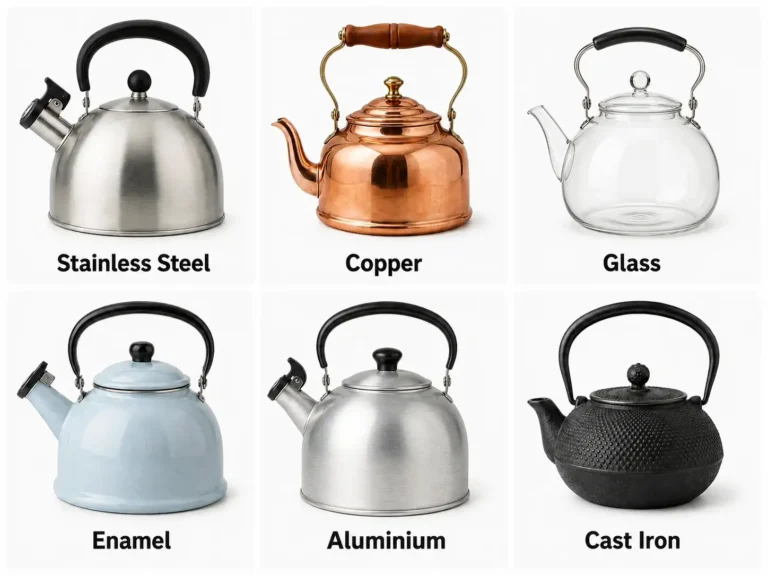
Stainless steel tea kettle: The workhorse. Soap and water outside, wipe with the grain, buff dry. Baking soda paste for scorch. Acid inside for scale. Never steel wool, never scouring powder on the polish; scratches give the next round of grime a place to grip.
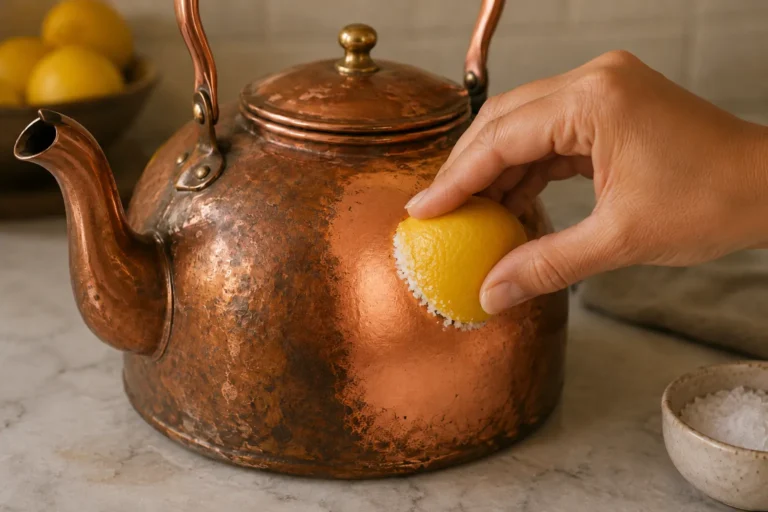
Copper tea kettle: Clean the inside as normal (it’s usually lined with tin or steel). For the outside, when the copper dulls to brown: cut a lemon in half, dip the cut face in table salt, and rub the copper in circles. Watch forty years of tarnish wipe off like it was never there. Rinse fast, dry faster: wet copper re-tarnishes while you watch. Ketchup on a cloth does the same trick (it’s vinegar and salt in a squeezable bottle), and yes, it feels ridiculous, and yes, it works.
Glass kettle: Descale as normal and the glass turns showroom-clear; the joy of glass is watching the scale let go. Outside, vinegar-damp cloth for spots, microfiber to finish. Streak-free glass is 90% drying technique: buff while barely damp.
Enamelled kettle (Le Creuset and friends): Soap and water outside, soft cloth only. Baking soda paste for stubborn marks, gently. Acid inside is fine; keep it off the painted shell and wipe drips the moment they land.
Aluminium tea kettle: Aluminium scratches and discolours easily, so keep it gentle. Use warm soapy water and a soft cloth outside. Descale the inside with a mild citric-acid solution, then rinse thoroughly. Avoid abrasive pads, steel wool and long acid soaks.
Cast iron tetsubin: Stop. Don’t scrub it, don’t descale it, don’t soap it. That pale mineral crust inside protects the iron from rust: it’s the one kettle where the scale is your bodyguard. Rinse with plain water, dry thoroughly over low heat, done. The outside takes a dry cloth and nothing else.
Fellow, Smeg and other precision kettles
Fellow Stagg (and other matte or coated kettles): the matte finish scratches easier than polished steel and dislikes vinegar. Damp soft cloth outside, nothing abrasive, and citric-based descaler inside, which is what Fellow themselves point owners toward. One dose, 20 minutes, flush the gooseneck spout slowly before rinsing.
Smeg and painted-body kettles: same rule: the shell gets soap-and-water and speed (wipe drips instantly); the inside takes acid freely.
How Often Should you Clean a Tea Kettle?
Outside wipe-down: weekly, thirty seconds, while the kettle’s warm.
• Inside descale: monthly in hard water areas, every 2–3 months in soft. Full schedule here.
• Tea-stain soda boil: whenever the walls turn brown; for heavy tea drinkers, monthly.
• Filter rinse (electric): monthly, same day as the descale. Pair the habits and you’ll forget neither.
And the habit that beats all cleaning: empty the kettle after each use. Standing water evaporates and leaves its minerals behind. An empty kettle scales at half the speed, spots less, and smells of nothing. One flick of the wrist per brew.
What Not to Do (Learn from Our Mistakes)
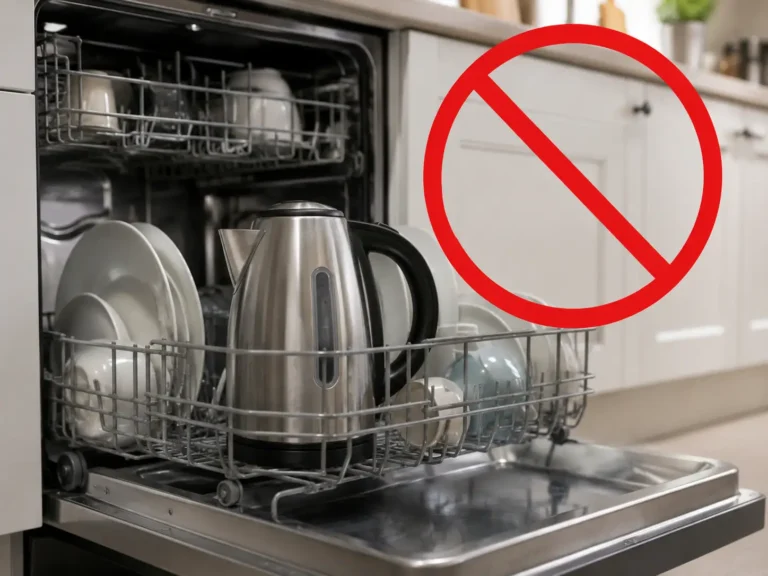
No bleach. Ever. It corrodes stainless steel, and if it meets leftover descaling acid it makes chlorine gas. Your kettle holds drinking water; bleach has no business anywhere near it. No dishwasher. Electric kettles die instantly (element, contacts, electronics). Stovetop kettles survive but
come out cloudy, with rattling whistle-caps and ruined handles. Two minutes by hand beats a dead kettle. No steel wool, no scouring powder on any surface you can see. Scratches are grime’s favourite home.
No long acid soaks on polished finishes. Twenty minutes to an hour does the job; overnight dulls the shine and gains you nothing.
QUICK FAQ
Where can I buy Keurig descaling solution near me?
Keurig-branded descaling solution is available from major retailers, although local stock varies. Halefresh descaling solution can be ordered directly online with free US shipping and is suitable for Keurig coffee makers.
Do I have to use Keurig’s own descaling solution?
No. Using another compatible descaler does not automatically void your warranty. However, Keurig may refuse warranty coverage if it determines that a non-Keurig product caused the damage, so always follow your model’s manual and the descaler’s dosing instructions.
How many descale cycles are in each bottle?
Each 16oz bottle of Halefresh provides 8 or more Keurig descaling cycles, depending on your machine, water hardness and the amount of scale inside it. The built-in dosing chamber lets you measure only what you need for each cycle.
Is Halefresh cheaper than the Keurig 14oz solution?
Yes. Keurig instructs users to pour in the entire 14oz bottle, making it a one-cycle product. Three Halefresh bottles provide at least 24 cycles, and our buy two, get one free offer works out at approximately $1.66 per cycle, compared with $13.99 per cycle at Keurig’s regular price or $7.99 when discounted.
Can I just use vinegar?
Yes, white vinegar can dissolve mineral scale, but it has a strong smell, can leave an aftertaste and generally requires more rinsing. Check your specific model’s manual first, then read our full section on how to descale a Keurig with vinegar.

