
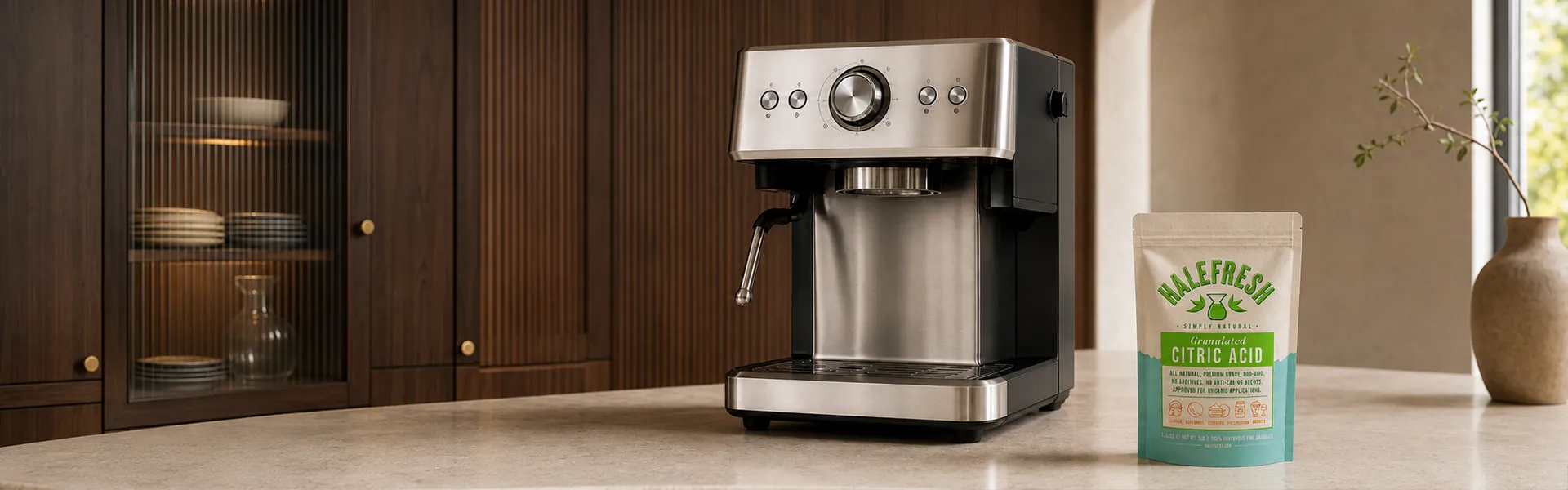
HOW TO DESCALE ESPRESSO MACHINE
(Step-by-Step for Breville, De'Longhi, and Every Brand in Between)
QUICK ANSWER
How to Descale Espresso Machine:
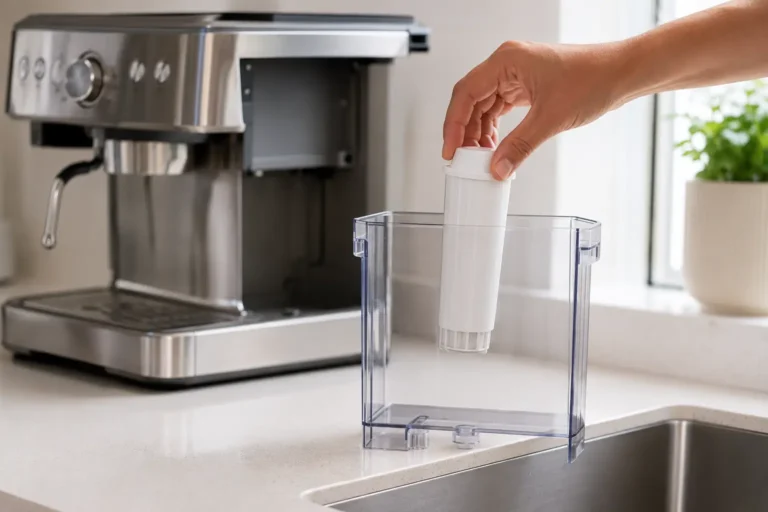
- Remove the water filter and empty the tank
- Fill the tank with descaling solution, or citric acid at 1–2 tablespoons per quart of warm water
- Run a third of the tank through the group head(no portafilter, no coffee)
- Run solution through the steam wand and hot water spout
- Let it sit 15–20 minutes, then run the rest through
- Rinse with 2 full tanks of fresh water, through every path
If your espresso machine has a built-in descale mode (Breville, De’Longhi super-automatics, Philips), use it — the brand guides are below.
For consistent results without mixing or measuring, use a purpose-made descaling solution
Why Listen to Us on This?
I ruined my first proper espresso machine. A Breville Barista Express, dead inside three years. The pump whined, the shots dribbled out cold, and when I cracked the case open, the thermocoil looked like a rock pool at low tide; crusted white, choked with scale.
That machine is part of why Halefresh exists. We make citric acid descaling products for a living, and we’ve descaled well over a hundred machines across every brand you can name.
So this isn’t theory. It’s scar tissue.
Signs your Espresso Machine Needs Descaling
Your machine will tell you. Look for:
- Shots slowing to a dribble
- Flat or sour-tasting coffee
- Sputtering instead of a steady pour
- Weak steam from the wand
- White flakes in the water tank or drip tray
- The descale light glowing
One of these, book a descale for the weekend. Two or more, do it today.
What Descaling an Espresso Machine Actually Does
Every time your machine heats water, the minerals in it, mostly calcium and magnesium, drop out and cling to the hot metal. That’s limescale.
In an espresso machine, it builds where you can’t see it:
- Inside the boiler or thermocoil
- Along the narrow water lines
- Around valves and restricted points
- Inside the steam path
Descaling flushes a mild acid through those hidden parts. The acid grabs the scale, dissolves it, and carries it out. Acid eats scale; water rinses acid. That’s the whole trick.
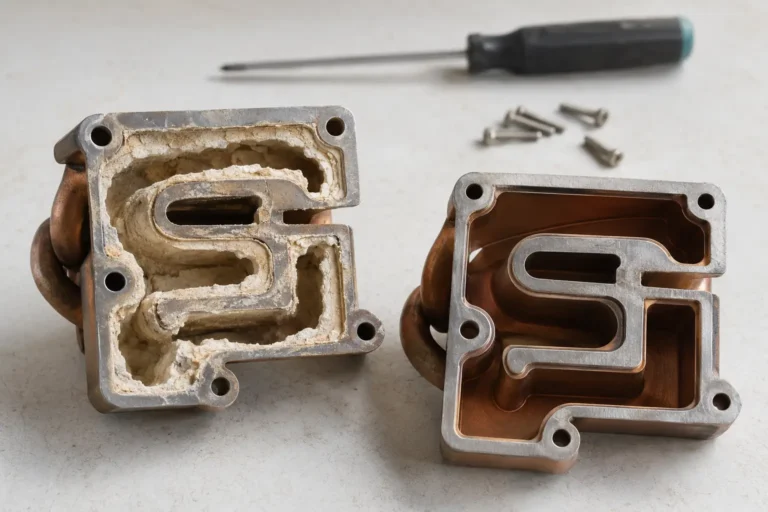
Inside the system. I’ve cut open boilers where the scale sat 3mm thick, layered like an eggshell.
Why it matters: scale is an insulator. It sits between the heating element and your water, so shots run cool, and cool water pulls sour, thin espresso. Scale also narrows the water path, drops your pressure, and wrecks extraction.
The owner’s complaint is always the same: “My espresso just doesn’t taste like it used to”.
What to Use: Descaling Solution, Citric Acid, or Vinegar?
This is where the internet fights. We’ve tested all of it, on machines we bought secondhand precisely because they were scaled to death.
Citric acid (the one we build our business on)
Citric acid is the acid in lemons. It dissolves limescale fast, rinses clean, and leaves no smell and no taste. It’s food-grade, so a stray sip of rinse water won’t hurt you.
The ratio: 1–2 tablespoons per quart of warm water (10–20g per liter). Stronger for an overdue machine, lighter for maintenance.
It’s also what most commercial descalers use as their working ingredient. Our own descaling solution is exactly this: food-grade citric acid, measured and ready. We keep it simple because the chemistry is simple.
Branded descalers
Breville’s sachets and descaling tablets, De’Longhi’s EcoDecalk, Urnex Dezcal — all work. If your machine is under warranty, the manufacturer’s own descaler removes any argument on a claim. Otherwise, read the label: most are citric, lactic, or sulfamic acid-based.
Vinegar: it works, and we still don't recommend it
PROS:
– Cheap
– Already in your cupboard
CONS:
– Clings, the smell survives multiple rinses
– Slower on scale than citric acid
– Degrades rubber seals over time
– Corrodes aluminum boilers, De’Longhi and Philips ban it outright
I once descaled a De’Longhi with a 50/50 vinegar mix and rinsed it four full tanks, and a week of espresso still carried a ghost of pickle brine.
If it’s vinegar or nothing and your manual allows it: 1 part white vinegar to 3 parts water, rinse three times, and buy citric acid before next time. For the full picture, read our guide to descaling with vinegar
Never run these through your machine:
Baking soda — it’s alkaline; scale only dissolves in acid. It will do nothing except sit in your water lines feeling smug.
Lemon juice — weak, sugary, pulpy. The pulp clogs the passages you’re trying to clear.
CLR or bathroom descalers — built for tubs, not for things you drink from.
How to Descale an Espresso Machine
(The Process in Pictures)
This manual method works for most home espresso machines without a built-in descale program. 20–30 minutes, and most of that is waiting.
You’ll need: descaling solution (or citric acid and a tablespoon), fresh water, and a large jug.
Check your manual first. Two minutes. Some machines have their own descale mode, see the brand guides below, and some manufacturers void warranties over the wrong descaler.
1. Remove the filter and empty the tank
• Pull the water filter from the tank
• Empty any old water
• Remove the portafilter (no coffee anywhere near this process)
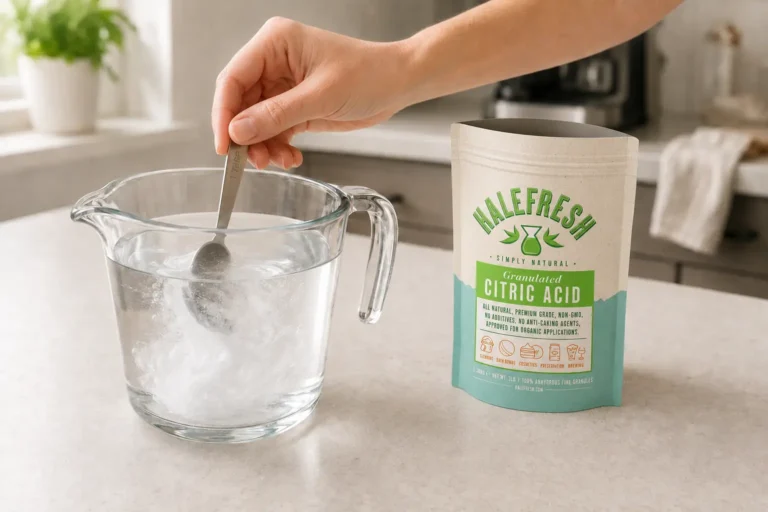
2. Mix your solution and fill the tank
Follow the directions on your descaling solution bottle. Or, if you are making your own (as shown below), use 1–2 tablespoons of citric acid per quart of warm water, stirred until the water turns clear. Warm water (105–120°F) dissolves the powder faster and works harder on the scale.
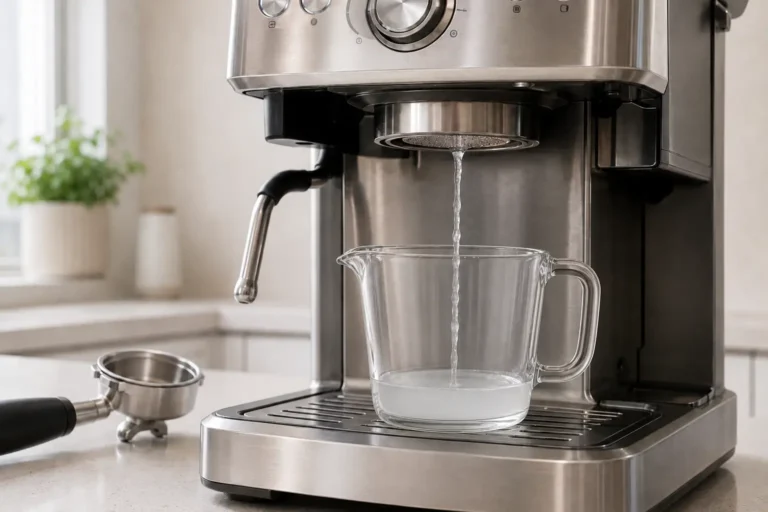
3. Run a third of the tank through the group head
Put an empty jug under the group head and run the machine like you’re pulling the world’s longest, saddest shot. No portafilter, no coffee, just solution moving through the hot path.
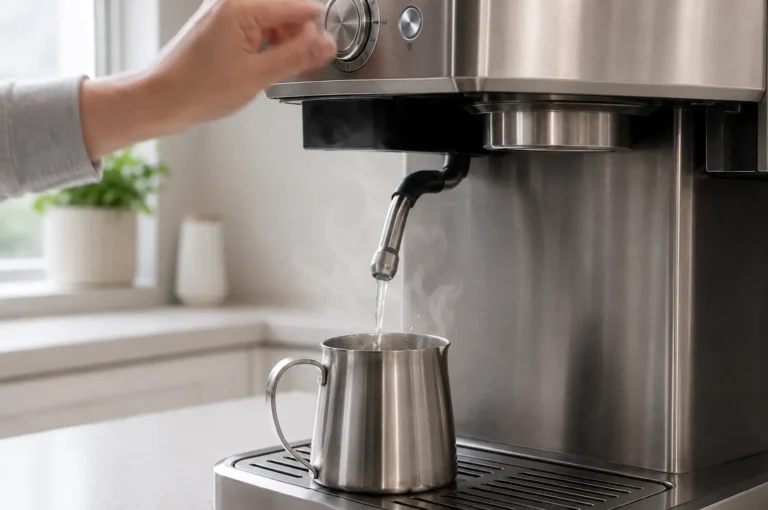
4. Run solution through the steam wand and hot water spout
Scale loves the steam path, it’s the hottest metal in the machine. Open the steam valve over the jug and let solution jet through, then do the same on hot water if your machine has a separate spout.
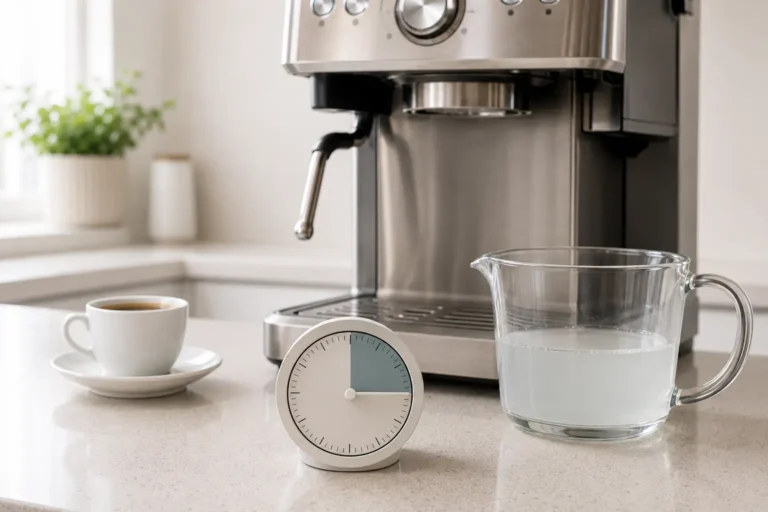
5. Let it sit 15–20 minutes
This is the step everyone skips and the step that matters most. The acid needs contact time to eat the scale, not just wave at it on the way past. Then run the rest of the tank through both paths.
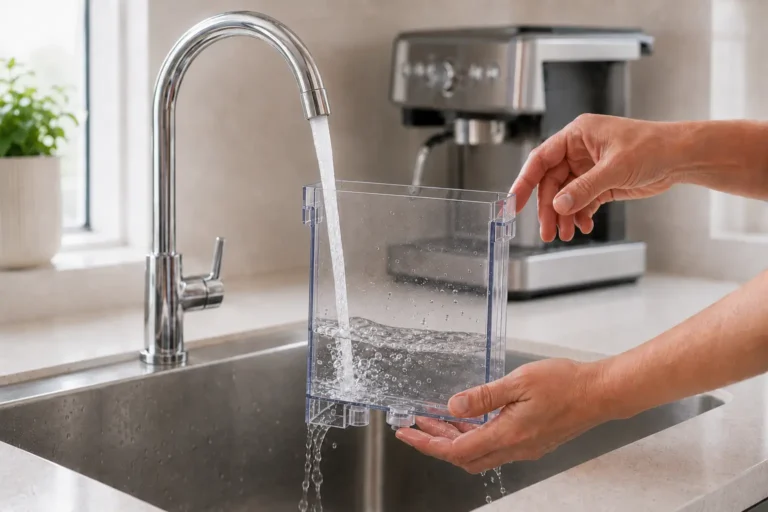
6. Rinse — then rinse again
- Repeat with a second full tank
- Rinse the tank under running water
- Fill with fresh water and run the whole tank through the group head, wand, and spout
The most common failure we see is partial descaling: loosened scale and leftover acid that never got flushed. Two full tanks, minimum.
7. The smell-and-look test
Run a little water into a clear glass. It should smell like water and look like water. Any tang or cloudiness — rinse again.
Then pull a shot. If your machine was overdue, you’ll taste it in the first sip: hotter, sweeter, thicker. That’s not magic. That’s your heating element finally touching water again.
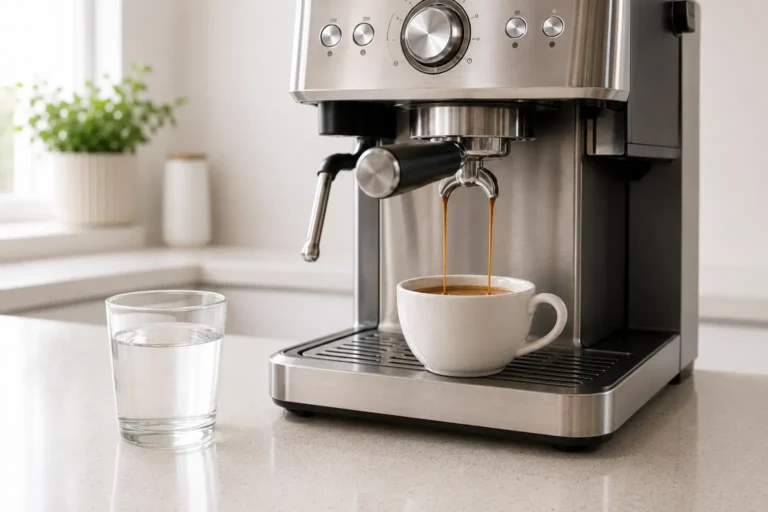
How to Descale a Breville Espresso Machine
Breville machines (Barista Express, Pro, Touch, Bambino) have a proper descale mode. Use it — it pushes solution through every path in the right order. The Barista Express version:
- Empty the drip tray, remove the water filter, and fill the tank with solution: one Breville sachet in a liter of water, or the citric acid mix above.
- Enter descale mode: with the machine off, press and hold the 2-CUP and POWER buttons together. When the POWER and 1-CUP buttons plus the CLEAN/DESCALE and HOT WATER/STEAM lights go solid, you’re in.
- Put a large (2 liter) container under the group head and wand.
- Press 1-CUP to descale the coffee path.
- Turn the steam dial to STEAM then to HOT WATER to descale those paths.
- Repeat steps 4 and 5 to use the remaining descaling solution.
- Remove and thoroughly rinse the water tank, then fill it to the MAX line with fresh cold water. Repeat steps 4 and 5 once to rinse the coffee, steam and hot-water paths.
The descale light resets when the machine logs a completed cycle, not when you feel you’ve done enough. If it’s still flashing, run the full cycle again from descale mode.
Press POWER to exit descale mode.
Can you descale a Breville with vinegar? You can, Breville doesn’t ban it. But the thermocoil’s narrow passages hold vinegar’s smell stubbornly. Citric acid rinses out in half the time.
How to Descale a De'Longhi Espresso Machine
Two rules cover every De’Longhi, from the Stilosa and Dedica up to the Magnifica super-automatics:
Rule one: no vinegar. Ever. De’Longhi boilers and thermoblocks are aluminum, and vinegar corrodes aluminum. This isn’t coffee-snob preferencel, it’s in their documentation, and we’ve seen the pitted boiler that proves it.
Rule two: dilute properly. EcoDecalk mixes 1 part descaler to about 10 parts water. A citric acid mix at the standard ratio does the same job for a fraction of the price — it’s the same acid family.
Manual machines (Stilosa, Dedica, EC-series): follow the process in pictures above — filter out, solution in, a third through the group head, steam wand, 15-minute soak, run the rest, rinse with two tanks.
Super-automatics (Magnifica, Dinamica, La Specialista): the machine holds your hand. Solution in the tank, start the descale program from the menu, big container under the spouts, follow the lights. Around 30 minutes, most of it hands-off, and the alarm clears itself.
Descaling Other Brands: The Quick-Fire Round
The chemistry never changes. What changes is the button dance:
KitchenAid — semi-automatics use the Clean cycle button; fully automatics have a Descaling setting in the menu that walks you through on-screen.
Casabrews and Chefman — simple water paths; use the process in pictures above. Small thermoblocks scale fast, so don’t stretch the schedule.
SMEG ECF01: has a dedicated descaling cycle operated through the machine’s controls. Follow the button sequence in your model’s manual.
Philips / Saeco — built-in descale programs and a firm no-vinegar stance; follow the prompts.
Ninja and Café (GE) — both flash a descale alert and walk you through from the panel.
Gaggia Classic — manual method, but read the next section first; older Classics with heavy scale can shed chunks into the solenoid valve.
Whatever the badge on the front, the acid doesn’t care. Mix, run, soak, rinse, sniff.
When you Should NOT Descale
Here’s the part most guides won’t tell you.
If you own a prosumer machine, an E61 group head, a heat exchanger, a dual boiler- think Rocket, ECM, Profitec, Lelit, do not casually run descaler through it.
These machines hide flow restrictors with holes under a millimeter wide. Blast a scaled boiler with acid and half-dissolved chunks break loose, ride the water path, and jam those restrictors. We’ve seen a Rocket Appartamento go from “slightly slow shots” to “no shots at all” this way, a descale that turned into a teardown.
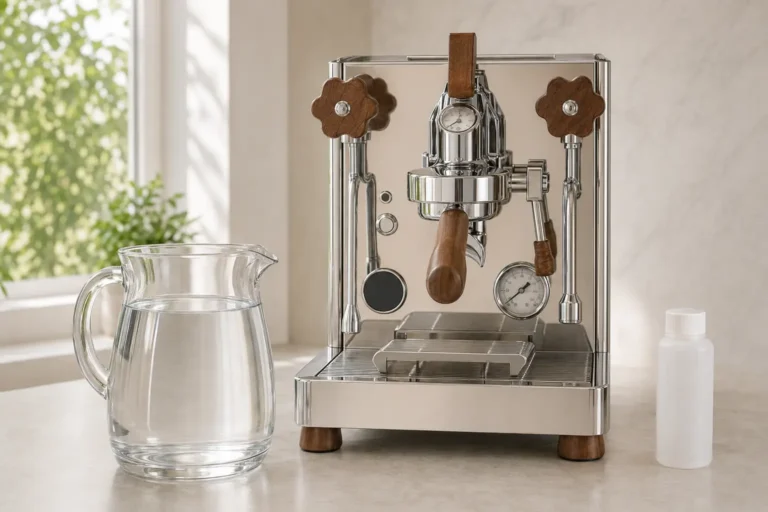
For these machines, the game is prevention:
- Feed them water around 30–50 ppm hardness; filtered, remineralised, or blended
- No minerals, no scale, no descaling
- If one is already scaled and struggling, descale it part by part (only bare metal parts soak in solution) or hand it to a technician
That’s not weakness. That’s a $2,000 machine.
For everything else, the Brevilles, De’Longhis, and their kin, descaling is routine care, and skipping it is how machines die.
How Often Should you Descale an Espresso Machine?
More often than the appliance brands tell you. “At least once a year” is the maintenance equivalent of flossing once a year.
The honest answer hangs on your water. Hard water carries more calcium and magnesium, so hard water grows scale faster — sometimes ten times faster than soft:
– Soft or filtered water (under 60 ppm): every 3 to 4 months
– Moderate water (60–120 ppm): every 2 to 3 months
– Hard water (120–180 ppm): every 6 to 8 weeks
– Very hard water (over 180 ppm): Mmonthly
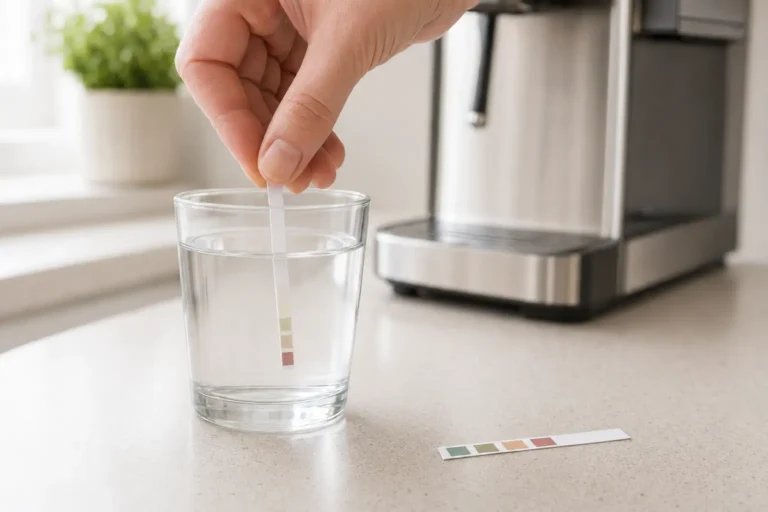
Don’t know your hardness? A test strip costs pennies and takes ten seconds. Your kettle is a clue too, if it scales quickly, your espresso machine is fighting the same water.
Descale before vacations; a machine sitting idle with mineral-heavy water grows scale while you’re at the beach. And treat a descale light as a deadline, not a suggestion.
For the full schedule logic, read our guide on how often to descale
*Ten seconds with a test strip beats guessing. Match your schedule to your water.*
Descaling vs Cleaning: Two Different Jobs
People use “clean” and “descale” as if they’re the same word. They’re not, and your machine needs both.
– Cleaning fights coffee — oils, fines, and residue on the group head, shower screen, and portafilter. Coffee oils go rancid, and rancid oil makes bitter, ashy shots. Cleaning uses a detergent (Cafiza, Breville tablets) and happens weekly-ish.
– Descaling fights water, the mineral crust inside the boiler and lines. It uses acid and happens on the schedule above.
Detergent won’t touch scale; acid won’t touch oil. Doing both the same day? Clean first, descale second, so the acid meets bare metal instead of coffee grime.
Your steam wand gets a wipe and purge after every single use. Non-negotiable, five seconds.
If your problem is residue rather than scale, start with our guide to cleaning a coffee maker

A thin surface film from coffee oils. A sign cleaning is overdue.
Common Mistakes to Avoid
- Skipping the soak — acid needs contact time, not a drive-by
- Rinsing once and calling it done — partial descaling leaves loosened chunks and leftover acid in the lines
- Descaling with the water filter still in the tank
- Using vinegar in a De’Longhi or Philips
- Waiting for the machine to struggle — by then, scale is already thick
- Blind-descaling a prosumer machine — reread the section above
Most machines don’t fail suddenly. Performance drops gradually and quietly.
What Happens if you Don't Descale?
The short version: what happened to my Barista Express.
Scale builds in silence. First your shots run a few degrees cool and a touch slow — subtle enough to blame the beans. Then flow drops as the passages narrow. The pump strains. The heating element, wrapped in its mineral blanket, runs hotter and hotter to push heat through the crust until one morning it doesn’t.
The repair quote for a scaled boiler often lands within shouting distance of a new machine.
The cost of prevention: a spoonful of citric acid and half an hour, a few times a year. We’ve descaled ten-year-old machines that pour like new. The only difference between those and the dead ones is the habit.
Frequently Asked Questions
How long does it take to descale an espresso machine?
20–30 minutes for a manual machine, most of it soak and rinse time. Super-automatics run about 30 minutes on their own program.
How much citric acid do I use to descale an espresso machine?
1–2 tablespoons per quart of warm water (10–20g per liter). Stronger for neglected machines, lighter for routine maintenance.
Can you descale an espresso machine with vinegar?
Sometimes, if your manual allows it — 1 part white vinegar to 3 parts water, rinsed at least three times. Never in a De’Longhi or Philips; vinegar corrodes their aluminum boilers. Citric acid works faster and rinses cleaner.
Do I need to descale if I use filtered water?
Less often, perhaps, but not automatically. Some filters improve taste without substantially reducing hardness. Test the filtered water and follow the hardness-based schedule above. If your kettle still develops white scale, your espresso machine is receiving the same scale-forming minerals.
What does the descale light mean, and how do I reset it?
It’s a counter — the machine tallies water volume against its hardness setting and flags you when scale is statistically due. It resets when you run the machine’s full descale cycle, not before. If it appears too often, check the water hardness setting matches your actual water.
Can I use a Keurig or universal descaler in an espresso machine?
If it’s citric acid-based, yes, the acid doesn’t know what machine it’s in. Check the ingredients and dilution.
Should I clean or descale first?
Clean (backflush) first, descale second. Acid works best on bare metal, not on a film of coffee oil.
Can descaling break my machine?
On a standard home machine at proper dilution with a proper rinse — no. On a heavily scaled prosumer machine, yes: loosened debris can clog the flow restrictors. Reread “When you Should NOT Descale” before pouring anything into a machine with an E61 group.
Your espresso machine asks almost nothing of you. Water, beans, a wipe-down, and a few times a year, half an hour with some citric acid. Do that, and it will outlive your car.
If you want the easy version, our pre-made descaling solution is the same food-grade citric acid we use on every machine in our workshop. No measuring. No guesswork. And if your machine does something strange mid-descale, write to us — we’ve probably seen it, and we answer.

